California Litigation Notice to Consumer or Employee and Objection Requirement When Serving Certain Deposition Subpoenas
As mentioned in our previous article, a litigant in California may command the appearance of a party or non-party to a deposition through the valid service of a notice of deposition. In addition to meeting several requirements, the deposition notice may also require the service of additional documents on additional persons or entities when subpoenaing consumer or employee records. This article provides a brief synopsis of the notice to consumer or employee and objection requirement when serving deposition notices in a civil litigation proceeding in the State of California.
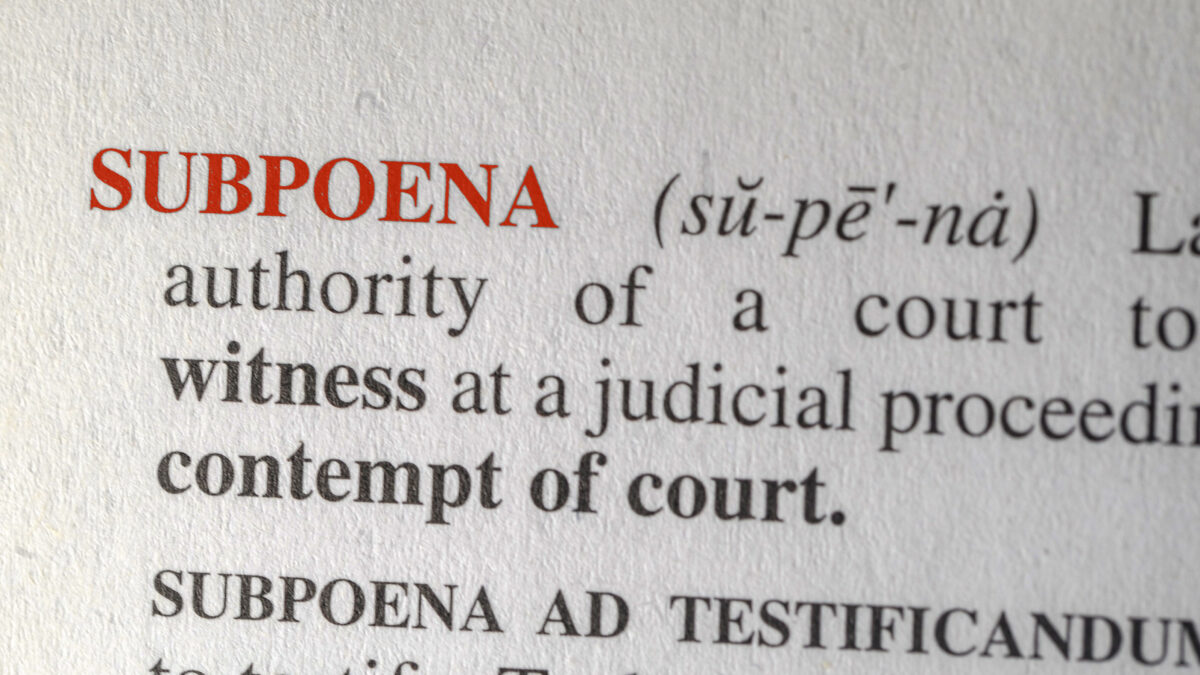
Where the party noticing the deposition notices the deposition by serving a Deposition Subpoena (California Forms SUBP-010, SUBP-020, SUBP-045) and the deponent is a witness commanded by a deposition subpoena to produce personal consumer or employee records, the subpoenaing party must serve three (3) documents on the consumer or employee:
- The deposition notice;
- A notice of privacy rights as specified in California Code of Civil Procedure sections 1985.3(e), 1985.6(e);
- California Code of Civil Procedure section 1985.3 establishes procedures for obtaining personal records of consumers by use of a subpoena duces tecum;
- California Code of Civil Procedure section 1985.6 provides requirements for seeking employment records of employees through a subpoena duces tecum; and,
- A copy of the deposition subpoena as specified in California Code of Civil Procedure section 2025.240(b).
Importantly, a noticing party’s failure to comply with California Code of Civil Procedure sections 1985.3 and 1985.6 is sufficient basis for a witness to refuse to produce, by a subpoena duces tecum, personal records of a consumer, or employment records of an employee. California Code of Civil Procedure §§ 1985.3(k), 1985.6(j).
However, these requirements do not apply to every situation where a deposition subpoena seeks consumer or employee records. These laws do not apply to a deposition subpoena that does not request a particular consumer or employee’s records, or that require the custodian of records to delete all personally identifying information for any consumer or employee. California Code of Civil Procedure §§ 1985.3(i), 1985.6(h). Additionally, these requirements do not apply where the subpoenaing party is the consumer or the employee, and they are the sole subject of the records sought. California Code of Civil Procedure §§ 1985.3(l), 1985.6(k).
In the context of California Code of Civil Procedure section 1985.3, personal records means the original or any copy of books, documents, or other writings, or electronically stored information pertaining to a consumer that are maintained by any witness. California Code of Civil Procedure § 1985.3(a)(1). Witness is defined as a physician, dentist, ophthalmologist, optometrist, chiropractor, physical therapist, acupuncturist, podiatrist, veterinarian, veterinary hospital, veterinary clinic, pharmacist, pharmacy, hospital, medical center, clinic, radiology or MRI center, clinical or diagnostic laboratory, state or national bank, state or federal association as defined under California Financial Code section 5102, state or federal credit union, trust company, anyone authorized by the state to make or arrange loans that are secured by real property, security brokerage firm, insurance company, underwritten title company, title insurance company, escrow agent (either licensed under California Financial Code section 17000; et seq., or exempt from licensing), attorney, accountant, institution of the Farm Credit System as specified in 12 U.S.C. § 2002, telephone corporation that is a public utility as defined in California Public Utilities section 216, a psychotherapist as defined in California Evidence Code section 1010, or a private or public preschool, elementary school, secondary school, or post-secondary school as described in California Education Code section 76244. California Code of Civil Procedure § 1985.3(a)(1).
Consumer is defined as any individual, partnership of five (5) or fewer persons, association, or trust that has transacted business with or has used the services of the witness or for whom the witness has acted as agent or fiduciary. California Code of Civil Procedure § 1985.3(a)(2).
Employment records mean the original or any copy of books, documents, other writings, or electronically stored information pertaining to the employment of any employee maintained by the current or former employer of the employee, or by a labor organization that has represented or currently represents the employee. California Code of Civil Procedure § 1985.6(a)(3). A labor organization is defined as means any organization or any agency or employee representation committee or any local unit thereof in which employees participate, and exists for the purpose, in whole or in part, of dealing with employers concerning grievances, labor disputes, wages, hours of employment or conditions of work, which labor organization is not found to be or to have been financed in whole or in part, interfered with, dominated or controlled by the employer or any employer association within one year of the commencement of any proceeding brought under this chapter. California Code of Civil Procedure § 1985.6(a)(3) & (4); California Labor Code § 1117.
Employee is defined as any individual who is or has been employed by a witness subject to a subpoena duces tecum. California Code of Civil Procedure § 1985.6(a)(2). Additionally, an employee may mean any individual who is or has been represented by a labor organization that is a witness subject to that subpoena duces tecum. California Code of Civil Procedure § 1985.6(a)(2).