
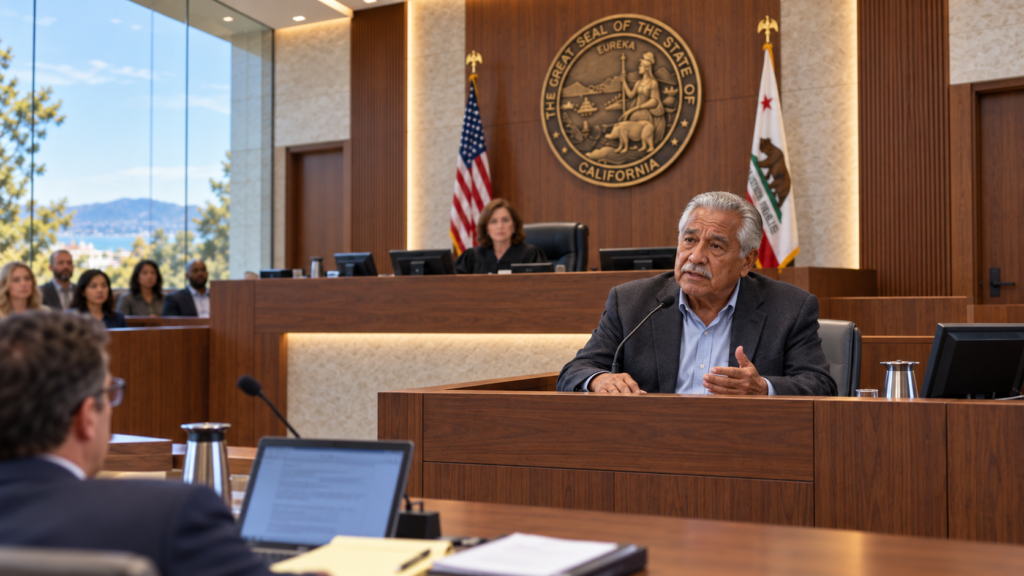
You’ve been called to serve as a witness in civil litigation for a friend. But, you’ve never served as a witness before. You’ve never participated in a civil litigation case in court. Your only perception of what a trial might be like is from television courtroom shows like Judge Judy. But, you know those programs are hyperbolic dramatizations produced for television and you do not expect your time in court, should you elect to serve as a witness, to resemble those television shows. So, what should you expect when you have been asked to serve as a witness in California civil litigation?
This article provides a brief overview as to what you can expect if you have bene asked to serve as a witness in California civil litigation.
Serving on a witness in a civil lawsuit is a very important undertaking. As a witness, you will appear in court – most likely physically – and offer your testimony before the parties, the spectators sitting in the public gallery, the attorneys, the court reporter, the deputy sheriff bailiff, the judge, and the jury. The attorney that requested your presence will initially examine you. Their examination is called a direct examination. Then, the defendant’s attorney, will examine you next. Their examination is called a cross examination. After the cross examination concludes, the first attorney may examine you once more for a short period. Throughout this process, your role is to listen carefully to each question and provide clear, truthful answers based on what you know and remember. Your testimony helps the judge and jury understand the facts and can meaningfully affect the outcome of the case.
Preparing for this responsibility begins with understanding your role as a witness and the kind of information you will be asked to provide. To begin, consider the capacity in which you will be called to testify: a percipient witness. A percipient witness in California civil litigation is a non-expert who offers testimony about matters personally perceived directly. Their testimony is generally restricted to facts, but they may offer opinions that are rationally based on their own common-sense perceptions, or where the opinion is helpful to a clear understanding of their testimony or to deciding a fact in the case. A percipient witness cannot offer specialized, technical, scientific, or professional opinions. Such testimony requires a qualified expert witness. They also cannot offer testimony based on hearsay, rumors, or things someone else told them out of court. Accordingly, your task is to provide a clear and truthful account of matters within your personal knowledge, while recognizing the limits of what you know and remember.
You were contacted to serve as a percipient witness because that person you know believes that you have critical personal knowledge as to factual events that will likely assist them as they pursue justice in court. Therefore, your testimony as a percipient witness is critical to the administration of justice in California and helping the parties to the lawsuit in which you participate uncover the truth.
During your time as a percipient witness, you will be asked to participate as a witness during the trial, in the event that the case proceeds to trial. A 2010 study found that only 4.4% of employment discrimination lawsuits reached trial. Gary Blasi & Joseph W. Doherty, California Employment Discrimination Law and Its Enforcement: The Fair Employment and Housing Act at 50 (UCLA–RAND Center for Law and Public Policy 2010). A 2026 study found that only a staggering 1% of eviction lawsuits in a single county court reached trial. N. Hardaway & Matthew Clair, Courthouse Funneling: How Organizational Mechanisms Teach Tenants to Bargain in Eviction Court, 60 Law & Soc’y Rev. 472–499 (2026). Further, the case could reach trial, but settle before you are called to offer your testimony at trial. However, you may also be requested to participate in other ways. For instance, you may be requested to provide a declaration containing a concise preview as to what you are to testify to during trial. The defense counsel may also subpoena you for a deposition shortly before trial. Accordingly, your firsthand knowledge may play an important role in preparing and resolving the case, even if you never take the witness stand at trial.
All testimony you provide—whether during a deposition, at trial, or through a declaration—is given under penalty of perjury. The law is clear: Perjury is a crime. The crime of perjury is defined as a false statement made, “under penalty of perjury.” California Penal Code § 118(a) (“[E]very person who…declares,…or certifies under penalty of perjury… and willfully states as true any material matter which he or she knows to be false, is guilty of perjury.”). Therefore, when participating in a trial as a witness it is important to ensure that your statements are always true and correct. If you execute an affidavit or declaration containing untrue statements or offer false testimony during a deposition or at trial, you will not only hurt the person who requested that you help them – by offering a sworn statement containing falsehoods, you severely undermine their case – but you also will commit crime: The crime of perjury. The most valuable assistance you can offer is an honest account of what you personally observed.
In terms of time commitment, serving as a witness in a California civil litigation matter will likely take a full day of your time in total. Half of that day will likely be spent working with the attorney and plaintiff to prepare for trial. And the remainder will be spent at deposition, should the defense counsel notice one, and at trial. Planning ahead for preparation, any deposition, and trial testimony can help minimize disruption to your work, family, and other commitments.
On that note, you have the right to take time off work to appear in court as a witness when complying with a subpoena or court order, provided you tender, “reasonable notice,” to your employer ahead of time. California Labor Code § 230(a). Further, while you cannot be paid for your testimony, you are entitled to a witness fee and a mileage reimbursement for your travel to and from the courthouse. California Government Code § 68093 (A subpoenaed civil witness is legally entitled to a flat fee of $35.00 each day and $0.20 for every mile driven round trip.).
Serving as a witness for the first time may feel unfamiliar, but thoughtful preparation and an understanding of the process can help you approach the responsibility with confidence. Whether you provide a declaration, attend a deposition, or testify at trial, your most valuable contribution is a clear and truthful account of what you personally know and remember. Listen carefully, acknowledge the limits of your recollection, and remain candid even when the facts may not favor the person who requested your help. By approaching this responsibility with honesty, care, and preparation, you help ensure that the case is evaluated on reliable evidence and contribute to the fair administration of justice.